
You have ideas. You are not short on them. What you do not have is a horizon further out than this week, so every day gets decided on its own, and the ideas stay ideas.
Or maybe your week looks different: full, reactive, one small fire after another, with no space to plan anything because you are always responding to what just happened.
Either way, you have probably assumed that structured planning is for businesses with a team behind them, not a business of one.
It is not. A 90 day business plan solopreneur style, built for one person rather than borrowed from a startup template, gives you a planning window long enough to see real progress and short enough to course-correct before it is too late to matter. This article gives you one planning session you can complete alone, this weekend, no consultant required.
Why Does 90 Days Fit a Team of One Better Than a Year?
Ninety days fits a team of one better than a year does because it is long enough to see real progress and short enough to course-correct before a wrong direction wastes months of a business with no one else to catch the drift.
A year is too long a unit for a solo business. Too much changes between January and December: a client disappears, a new opportunity appears, your energy shifts.
The plan you wrote in January quietly stops matching your life by March. It gets abandoned, and abandoning it feels like a personal failure, when really the format was wrong from the start.
A week, on the other hand, is too short to hold a real goal. You can plan a week's tasks, but you cannot see whether they are adding up to anything from inside a single week.
The part most planning content leaves out is this: the plan's real job is not to map everything you could do. It is to filter out everything you should not be doing this quarter.
When everything feels equally urgent, which is the exact trap both a scattered week-to-week operator and a reactive, crisis-mode operator fall into, a 90-day plan gives you one question to ask before saying yes to anything new: does this belong in this quarter, or not.
This matters more for a business of one than most planning advice admits. In a company with a team, a manager can hold the plan in view while individual people execute pieces of it. There is no one else to hold your plan for you.
If it lives only in your head, it competes every single day with whatever feels most urgent in that moment, and urgency almost always wins over importance.
A written plan, referred to weekly rather than filed away, becomes the thing that argues back when a new, shiny, off-plan opportunity shows up mid-quarter. It does not mean saying no to everything new forever. It means saying “not this quarter” with a specific reason already written down, instead of deciding in the moment, tired, with no framework to check the decision against.
Planning Around the European Calendar, Not Against It
A European solo business's 90-day cycle should be timed around the real summer slowdown, not against it, because the slowdown is measurable, not a mood.
Most quarterly planning content is written for US-based startups and assumes twelve steady months. That assumption does not hold across much of Europe.
Booking data shows average European hotel rates dropping 11 percent in August compared to their June peak, with Spain down 13 percent and Italy down 15 percent, a reasonable proxy for the wider business slowdown across the same period.
The pattern is cultural as much as economic: Norway's “fellesferie” tradition sees roughly half the national workforce take a three-week break in July, and the same slowdown is entrenched across France, Italy, Cyprus, Portugal, and Greece, each with its own local rhythm.

The slowdown, in numbers
European hotel rates fall an average of 11 percent in August versus June, with Spain and Italy dropping further still. In Norway, close to half the workforce takes a concentrated three-week break in July. Whatever your country, expect July and August to move slower, and plan your quarter boundaries around that instead of pretending every month is equal.
This means a European solo business often does better with quarters that do not mirror the standard calendar-year split. A quarter running September through November, capturing the post-summer reset and the run into Q4, or one running January through March, tends to fit better than one that starts in July and immediately runs into the slowdown.
Use late summer for the planning and reflection your 90 days need, not for pushing hard on new client work that most of Europe is not available for anyway.
This is not the same slowdown everywhere, and that is worth naming rather than smoothing over. Nordic countries tend to concentrate the break into a shorter, more intense July pause, closer to the fellesferie pattern, while Southern European countries spread the slower period across both July and August.
If most of your clients are in one region rather than another, let that shape your own quarter boundaries rather than defaulting to a generic template built for a single, undifferentiated “European summer.”
The Solo Sprint Framework: One Plan, Three Parts
The European Profit Reality Check walks your last three months of revenue through four steps, VAT, direct costs, marketing and sales, and tax, so what is left at the end is your real, spendable profit, not a guess.
When you do it: At the start of each quarter, ideally timed to the European calendar section above, and never mid-crisis, when the plan needs a clear head to write it

Total Time Needed :
45
Minutes
What will you need:
– your last quarter's real numbers if you have them,
The three parts:

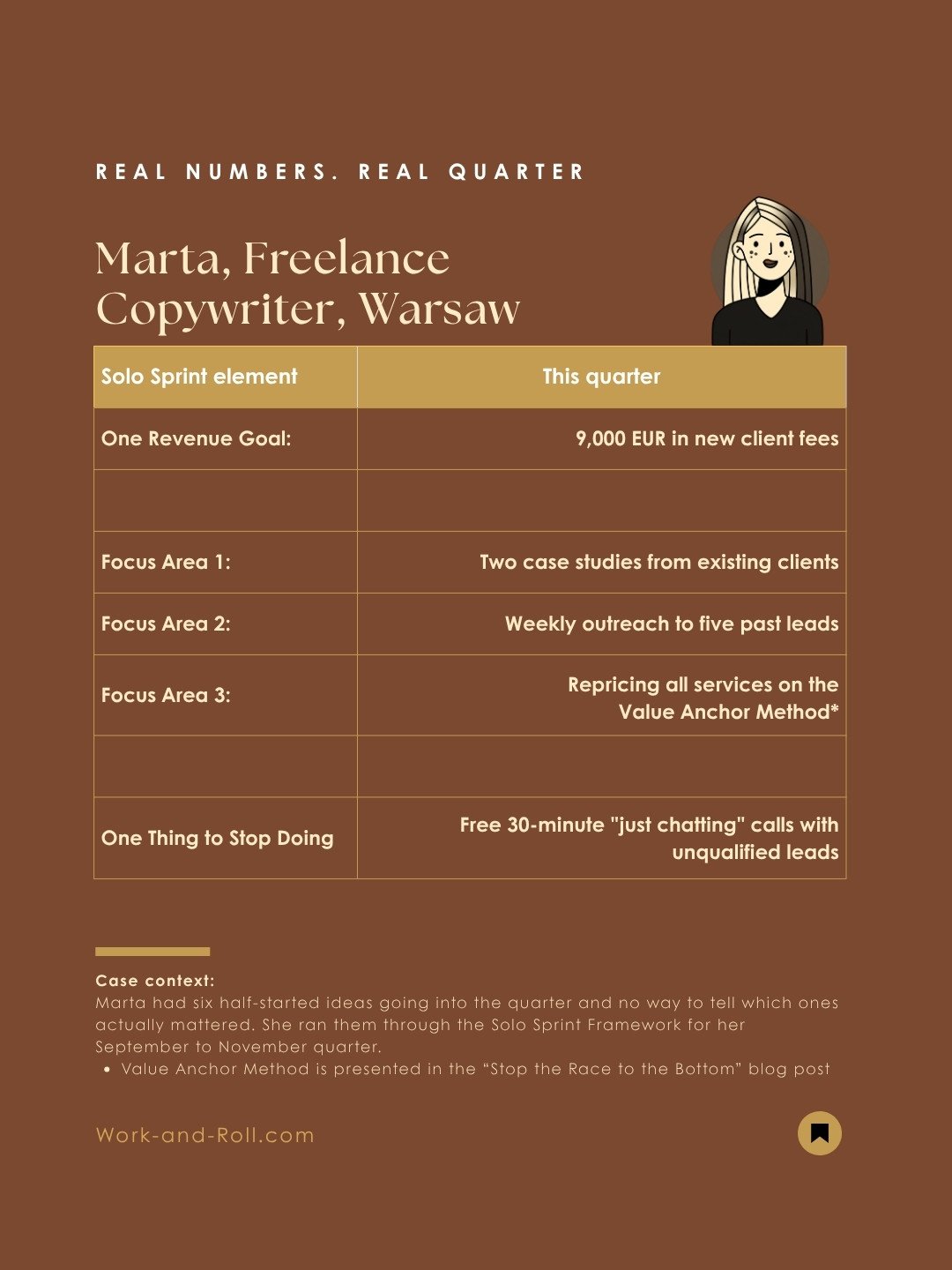
Choose a single, specific number that defines success for the quarter. Not a range, not a wish, one number you will know you either hit or did not.
Ask yourself: “If I only look at one number at the end of these 90 days, what number tells me this quarter worked?“

Name the only three things that will get real attention this quarter. Everything else, however tempting, waits until the next one..
Ask yourself: “Of everything I could work on, which three actually move me toward my revenue goal?“

Choose something currently taking your time or energy that you will deliberately drop for the quarter. A solo business cannot keep adding without also subtracting somewhere
Ask yourself: “What am I still doing out of habit or guilt that is not earning its place in these 90 days?“
90 Day Business Plan Solopreneur: The Short Version
If you only take one thing from this method: name one revenue goal, pick three focus areas that actually serve it, and choose one thing to stop doing to make room. That is a 90 day business plan solopreneur can build alone, on one page, without a consultant.
How Do You Build Your Solo Sprint This Weekend?
Building your Solo Sprint takes one page and about an hour, no retreat or strategy day required.
Sit down with three questions in front of you. What one number defines success for the next 90 days? Which three things will actually get your attention, and only those three? What is one thing you will stop doing to make room for them? Write the answers down. That page is your plan.
Picture how this plays out for two different starting points. If your week currently looks scattered, full of ideas with no horizon, the Solo Sprint forces a choice: instead of ten half-started ideas, you pick the three that actually serve your one revenue goal, and the other seven wait for a future quarter.
Not because they are bad ideas, but because a business of one cannot chase ten things at once and finish any of them. If your week looks more reactive and crisis-driven, the plan works differently: it gives you something to return to when a fire pulls your attention, a page that says “this is what actually matters this quarter,” so a single bad Tuesday does not quietly become a plan-less month.
Pin your page somewhere you will see it weekly, not filed away until the quarter ends. A Solo Sprint plan only works if it stays alive, checked against, adjusted if something in your three focus areas turns out to be wrong.
That is not a failure of the plan, it is exactly what a 90-day window is for: short enough to notice, long enough to still have time to fix it. At the end of the 90 days, before writing the next Solo Sprint, spend ten minutes reviewing what actually happened against your one number, so each quarter's plan gets a little more accurate than the last.
Your next steps: