“Good lord. Trying to figure out what I have to offer is the hardest part!”
A woman wrote that under a video about starting a business later in life. She wasn't asking for a list of business ideas. She already has the ideas buried somewhere in fifteen or twenty years of doing real work. What she was missing was a way to see it.
If you want to turn expertise into a business, the obstacle is almost never a lack of skill. It's that nobody ever taught you how to look at your own experience and pull a sellable offer out of it. Business plans assume you already know what you're selling. Niche quizzes assume you already know what makes you different. Neither one helps you get there.
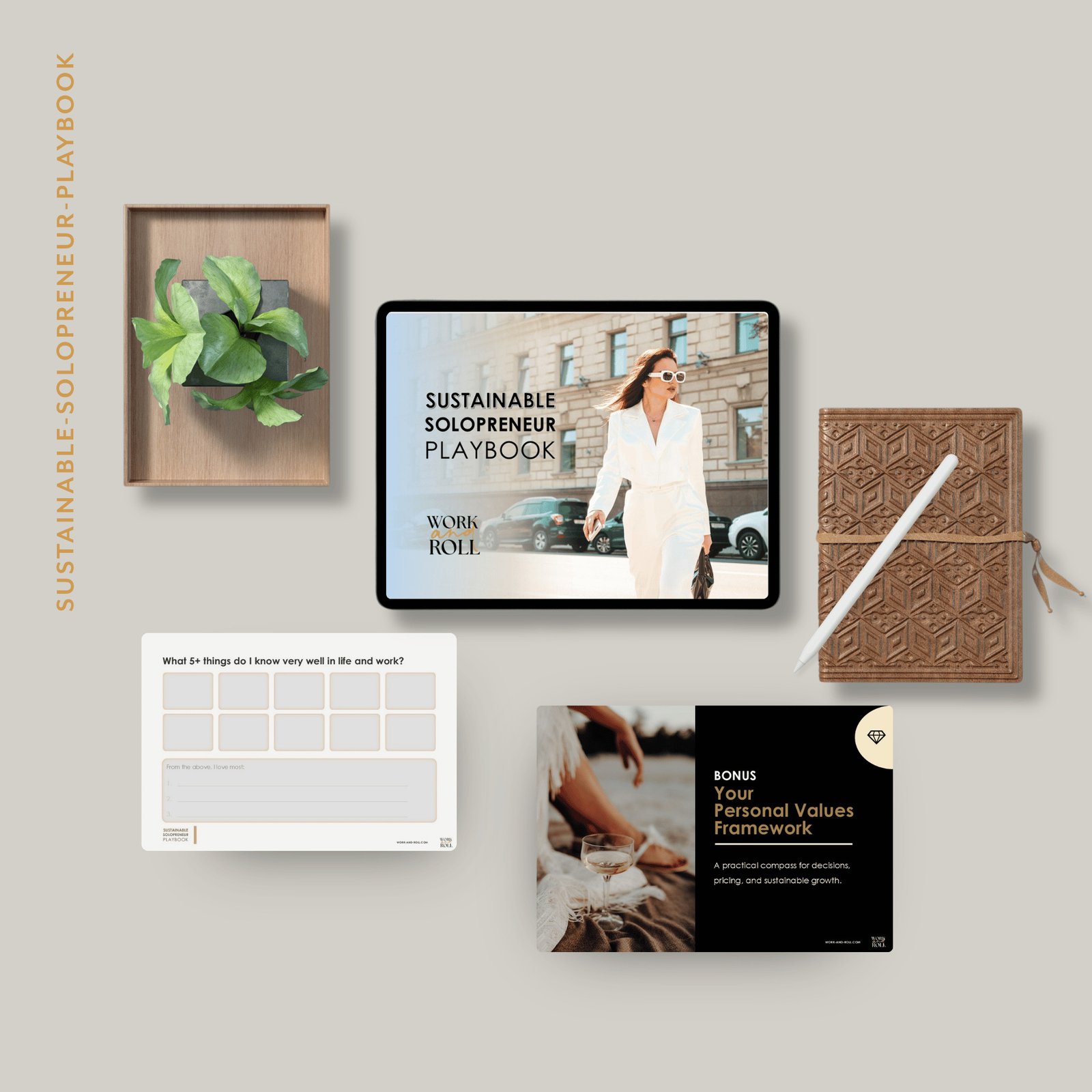
This article gives you the missing step: a short, structured way to inventory what you actually know, spot what repeats, filter it through what matters to you, and shape it into one sentence you could say out loud to a stranger. It's called the Experience Ledger, drawn directly from the self-inquiry sequence in Work and Roll's own Sustainable Solopreneur Playbook, condensed into something you can do this weekend.
This is not a niche quiz or a personality test. It is a way to turn skills into income you can actually name, price, and describe in one sentence, instead of a vague sense that you're “good at a lot of things.”
Why Does “I Don't Know What I Have to Offer” Feel Like the Hardest Part?
It feels like the hardest part because naming your own value is a genuinely different skill than doing the work, and almost nobody ever teaches it on its own. Here's why it catches so many women off guard:
That invisibility is the real problem, not a shortage of expertise, a shortage of a mirror. Every framework that skips straight to “pick your niche” or “write your business plan” hands you a form to fill out before anyone has shown you what's actually in the drawer.
Multiple independent freelance-industry studies, including Upwork's Freelance Forward research, consistently find that referrals and existing relationships are the most commonly cited source of a freelancer's first clients, though the exact share varies by study.
Your existing relationships already know what you're good at. The “Experience Ledger below” helps you catch up to what they already see.
The Experience Ledger: A 4-Step Way to Turn What You Know Into What You Sell
The Experience Ledger is a four-step method that turns an unsorted pile of experience into one clear, sellable offer statement, in roughly an hour. It follows the same sequence used in the Sustainable Solopreneur Playbook's own self-inquiry pages:
When you do it:
Before writing a business plan or choosing a niche, not after. If you've already written a plan and it still doesn't feel like “you,” this is also the right moment to redo it

Total Time Needed :
1
Hour
What will you need:
The Four Steps:

Ask yourself: “What do I know well, what do people already ask me for help with, and what would I be proud to be paid for?“
Write three separate lists:
– What I know well
– What people already ask me for help with
– What I'd be proud to be paid for
Don't edit yet, and don't judge what belongs on a “real” business list. A skill you've had for fifteen years can feel too obvious to count; write it down anyway.

Ask yourself: “What shows up more than once across all three lists?”
Circle anything that repeats. A single mention might be a fluke. Anything appearing on two or three lists is a real signal, not a guess, about where your actual value sits.

Ask yourself: “Which one or two of my non-negotiable values does this item honor, and which would it betray?“
Take your top 1-2 personal values and hold each circled item up against them. Drop anything that would require compromising a non-negotiable, even if it would sell well. A business built against your own values rarely stays sustainable.

Ask yourself: “Who do I help, what do they get, and what pain does it help them avoid?“
Combine what survives Steps 2 and 3 into one sentence:
“I help [who] get [what], avoiding [what pain], through [how].”
This sentence is a draft, not a tattoo. It exists so you have one clear thing to say instead of a shrug.
Let's See How Does This Look in Practice
It looks like a real conversation with yourself, not a worksheet you fill in silently. Below are two illustrative examples of what it actually sounds like to turn expertise into a business, each following one persona through all four steps in her own words.
The two examples are deliberately different. One is a straightforward yes. The other surfaces a harder decision, because the Experience Ledger doesn't always end in a clean win.
Example 1: Renata's Conversation

Renata
Former HR Manager, Warsaw
Step 1, Inventory
What do I know well? Employment law basics, mediating conflict between people who hate each other, writing job descriptions nobody else wants to write, staying calm when someone is crying in my office.
What do people already ask me for help with? My sister asks me to review her freelance contracts. Two former colleagues have messaged me this year about handling a difficult manager. My neighbor asked me to help her write a resignation letter that wouldn't burn a bridge.
What would I be proud to be paid for? Helping someone leave a bad work situation with their dignity intact. That one surprised me. I never thought of it as a service.
—
Step 2: Pattern Spotting
One thing shows up three separate times without me planning it, helping someone navigate a hard conversation at work:
List one: mediating conflict
List two: reviewing contracts and handling a difficult manager
List three: leaving with dignity
That's not a coincidence. That's the pattern.
—
Step 3: Values Filter
My top two values are honesty and calm.
Does “helping people navigate hard work conversations” honor them? Yes, that's the whole point of the service, staying honest and steady when someone else can't.
Does it betray either one? No. If anything, this is the most values-aligned item on either list.
—
Step 4: Shape the Offer Statement
“I help mid-career professionals get through difficult workplace conversations, contract reviews, conflict, or resignations, avoiding the panic and bridge-burning that usually comes with doing it alone, through calm, HR-trained guidance from someone who has sat on the other side of that desk for fifteen years.”
That sentence didn't exist an hour earlier. Nothing about Renata's experience changed. What changed is that she could finally see it.
—
One week later
I said my offer sentence out loud to my sister first, then to a former colleague.
My sister's face changed the second I said “leaving with dignity intact.” She said, “Wait, that's a real thing people would pay for?”
That reaction told me more than an hour of overthinking ever did. I still don't have a logo or a website. I have one sentence I trust, and that turned out to be the part I was actually missing.
Example 2: Kate's Conversation

Kate
Ceramic Artist, Lisbon
Step 1, Inventory
What do I know well? Throwing on the wheel, glaze chemistry, small-batch firing, packaging fragile things so they survive the post.
What do people ask me for? Custom mug commissions, wholesale inquiries from two cafés, and lately, other makers asking me how I price things.
What would I be proud to be paid for? The making itself. Standing at the wheel for four hours and losing track of time. That's still the truest yes on the whole page.
—
Step 2: Pattern Spotting
“The making” repeats everywhere: in what I know, what I love, what I'd be proud to be paid for. But something else repeats too, and I almost didn't write it down:
– Dealing with the wholesale accounts
– Chasing the café's late invoice
– Redoing my Etsy listings for the third time this year
All three show up as things I dread, not things I'm good at. That's a pattern as real as the first one. It's just not the one I wanted to find.
—
Step 3: Values Filter
My top two values are creativity and freedom.
Does the making honor them? Completely.
Does running the wholesale side honor them? No. Chasing invoices and managing two café accounts is the opposite of freedom, and it hasn't left me any energy for creativity by the time I get to the wheel.
I must be honest here: I'm not undercharging because I don't know my worth. I'm exhausted because I've been running the management half of this business alone, the half I never wanted and I'm not actually skilled at, and it's quietly draining the half I love.
—
Step 4: Shape the Offer Statement
My offer sentence isn't just about what I sell, it also has to include what I stop doing:
“I help people bring handmade, small-batch ceramics into their homes and cafés, through my own studio practice, not through managing wholesale accounts and admin myself.”
Kate's honest finding wasn't a new niche. It was that the craft and the business, as currently structured, were pulling against each other, and that her burnout wasn't a sign to quit, it was a sign to redesign which parts she does alone.
—
What Kate Actually Decided to Change
Kate didn't leave ceramics, and she didn't try to force herself into becoming a better bookkeeper or account manager either. She kept the making, which stayed a clean values match, and changed how the business around it is structured:
Approached a local concept store about a consignment arrangement, so the shop handles retail relationships and she delivers finished pieces on a schedule.
Declined one of the two café wholesale accounts directly, kept the other, and moved its invoicing to a once-a-month automatic system instead of chasing it manually.
Blocked two mornings a week for the admin that's left, instead of letting it interrupt studio time all week.
Nothing about her skill as a maker changed. What changed is that she stopped asking herself to also be a business operations manager, a role nowhere on her Step 1 list of things she knew well or was proud to do.
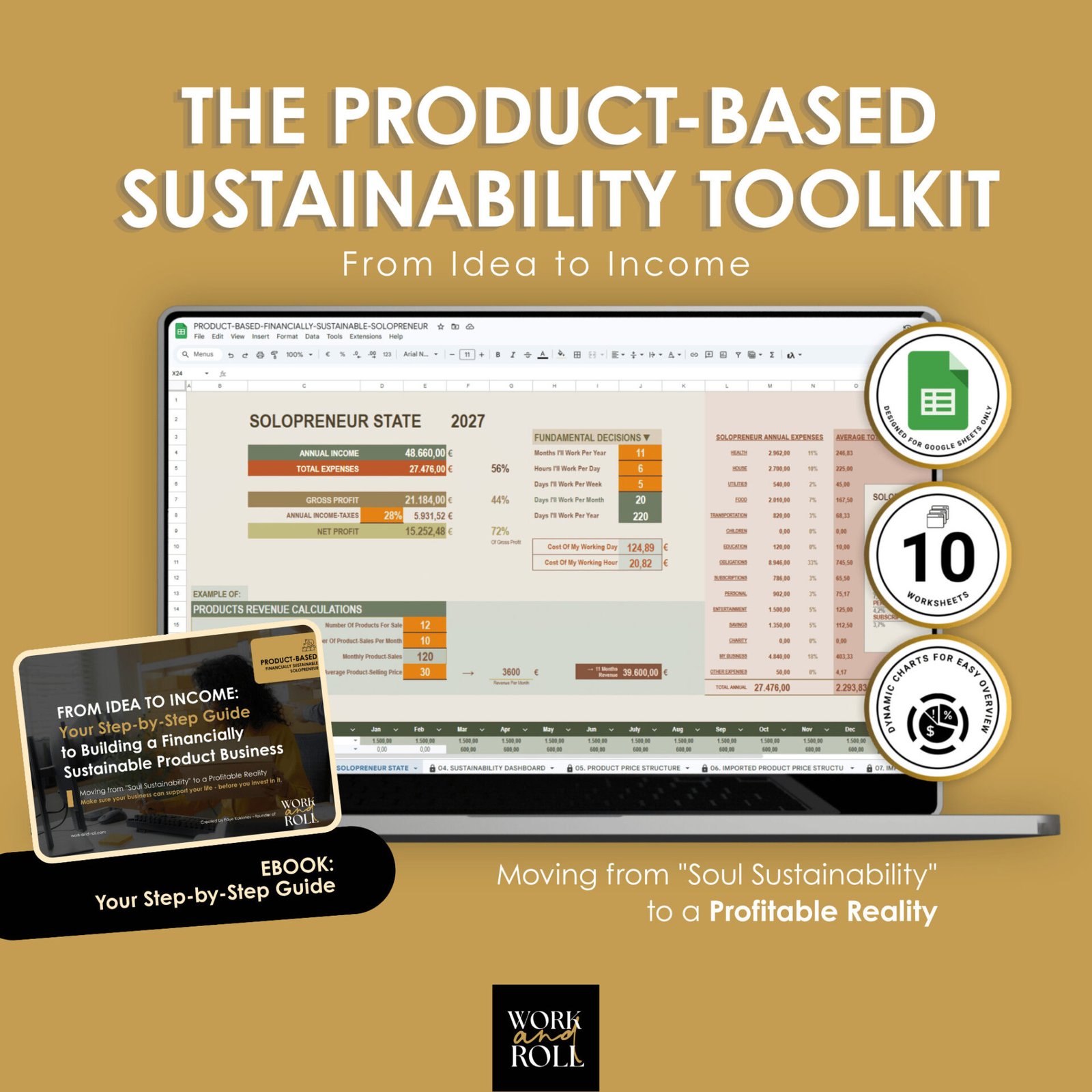
If Kate's version feels closer to your own situation, the next real question isn't “what's my niche,” it's “what does this actually cost me to run the way I'm running it now. “The Financially Sustainable Product-Based Solopreneur Toolkit” is built for exactly this: calculating your true product cost, your Cost of My Working Hour, and your Sustainability Dashboard, so a decision like Kate's is based on real numbers, not just relief.
Turn Expertise into a Business: The Short Version
To turn expertise into a business, run your experience through four steps in order:
Do this before writing a business plan, not after, since the plan only works once you know what you're actually planning around.
Your Offer Statement Is a Draft, Not a Finished Business Plan
Treat your offer statement as a working draft to test in real conversations, not a document to perfect alone. Here's what to do with it this week:
The Sustainable Solopreneur Playbook, the free resource this framework is drawn from, walks through this same self-inquiry sequence in full, alongside the lifestyle and “ideal day” questions that shape not just what you offer, but the kind of business that would fit your life. Once that groundwork is done, the Playbook points you toward the Financially Sustainable Service-Based or Product-Based Toolkit for the pricing and profit side.
You already did the hard part by living the experience. The Experience Ledger just gives it a shape someone else can say yes to. That is the whole difference between having expertise and being able to turn expertise into a business: not more skill, just a way to see the skill you already have.
Your next steps: