
You finish a project in half the time it used to take you. The client is thrilled. The result is exactly what they needed. And you earn less than you did two years ago, because you billed by the hour, and the hour got shorter as your skill got better.
If you have ever wondered how to price services as a freelancer without punishing yourself for getting good at your job, here is the honest answer. The hourly rate is not a safe, neutral default. It is a structural flaw that charges you for being efficient.
This is not about confidence, and it is not something wrong with you. It is a pricing model mismatched to what you actually sell, which is a result, not a block of time. By the end of this article, you will have a named, three-step method for how to price services as a freelancer on what they are worth, not on how long they took
Why Does Charging by the Hour Punish Your Expertise?
Charging by the hour punishes expertise because the better you get, the faster you deliver, and the faster you deliver, the less you earn for the same client outcome. Hourly pricing rewards slowness. It penalizes exactly the skills you spent years building, and it caps your income at the number of hours in your day.
Think about what actually happened in your first year compared to now. A strategy document that took you twelve hours back then might take you four hours today. Same quality, often better. Under hourly pricing, that improvement in your skill directly reduces your income, unless you keep raising your hourly rate just to stand still, which most service providers do not do consistently enough to keep pace with their own growth.
Three ways hourly pricing works against you:
There is also a quieter cost. When a fixed price is on the table, there is no hourly number for a client to push back against, which tends to shorten the negotiation itself rather than lengthen it. An hourly rate invites a client to ask you to work faster, or fewer hours, or “just a quick call.” A results-based fee does not offer that lever, because the fee was never tied to your clock in the first place.
What Is Undercharging Actually Costing You?
Undercharging costs you far more than the missing income on each invoice. It compounds across every client, every quarter, and every year you keep the same underpriced rate. European Union data on the general pay gap and independent studies on freelance rates both show that women consistently charge less than men for comparable work, and Value Added Tax further reduces what you actually keep. This section shows you the real numbers.
Start with the number the European Union itself reports: the general pay gap for work of equal value across the EU, covering both freelancers and permanent employees, is 11 percent.
Among freelancers specifically, a global study by Remitly, analyzing rates for 58,261 freelancers across major platforms, found the picture varies sharply from one European country to another when it comes to how freelancers price their services. In Hungary the freelance gender pay gap reached 45.0 percent, in the Czech Republic 40.1 percent, and in Romania 33.3 percent. In the same study, Croatia showed a gap of just 2.1 percent and Portugal close to 3 percent, among the narrowest gaps recorded worldwide.
Within specific service categories, the same study found Management Consultants facing a 22.8 percent gap and Bookkeepers 24.4 percent, comparable in scale to the roughly 38 percent gap OnDeck separately found in accounting and consulting freelance work. This is precisely why learning how to price services as a freelancer on value, rather than defaulting to whatever feels safe, matters so much: the gap is not fixed, it responds to how you price, not just who you are.
What this tells you is not that undercharging is universal and unavoidable. It is that the gap is real, it is measurable, and in some European countries it is dramatically wider than in others, which means it responds to something changeable, not to some fixed law of the market.
From more than three decades working in and consulting on European labor markets, this pattern is not surprising. It shows up repeatedly among European service providers too, in client conversations, in fee proposals compared side by side, in the quiet decision to round a fee down rather than up. It is a lived pattern here as much as the country-level data above suggests, even where a precise number for a given country is not yet published.
EU standard VAT rates in 2026 range from 17 percent in Luxembourg to 27 percent in Hungary, with an EU average close to 21.8 percent. Depending on how you invoice, VAT can either add on top of your quoted price or be included within it. Both scenarios matter, and confusing the two is one of the most common pricing mistakes.
Put real numbers on it. Two scenarios, both realistic.
Scenario A: Net rate plus VAT (typical for Greek B2B invoicing). You quote a net hourly rate of 100 EUR to a Greek client. Calculation: Net service value 100 EUR + VAT 24% (24 EUR) = Total Invoiced Amount 124 EUR. Your client pays 124 EUR. You keep 100 EUR. The 24 EUR belongs to the tax authority from the moment you collect them.
Scenario B: Total amount with VAT included (typical for B2C receipts). You quote a total price of 100 EUR to a consumer, VAT included. Calculation: 100 EUR ÷ 1.24 = 80.65 EUR net + 19.35 EUR VAT (24%). Your customer pays 100 EUR. You keep 80.65 EUR. The 19.35 EUR belongs to the tax authority.
Note on intra-Community B2B: When you invoice a business client in another EU country, the VAT rate is 0% (reverse charge applies), so the net amount you quote equals the total. This is why many European freelancers work at different real rates depending on where their client is based.
The lesson is simple. Price from what actually lands in your account after VAT is set aside, not from the number on the invoice. Then keep going, because VAT is only the first cost to strip out.
The Value Anchor Method: How to Price on Results in 3 Steps
The Value Anchor Method is a three-step pricing method that moves you from charging for your time to charging for the result the client receives. Step 1 names the outcome. Step 2 quantifies what that outcome is worth to the client. Step 3 sets your fee as a defensible share of that value, then checks it against every real cost of delivering the work.

Total Time Needed :
30
Minutes
Required Tools:
– Honest information about the client's business (or realistic estimates)
Only follow the three simple steps:

Define the concrete result the client receives, not the hours you spend producing it. Not “ten hours of strategy consulting” but “a pricing structure that stops undercharging and adds a defined amount to her monthly income”.
Ask yourself: “If the client described this project to a colleague in one sentence, what would she say she got, not what would she say I did?”

Estimate what that outcome is worth to the client, in money gained, time saved, or risk avoided. This does not need to be exact. It needs to be real and defensible.
Ask yourself: “What is this worth to her, in numbers she would recognize as fair?”
Worked Example: if your pricing consulting typically adds 15 to 20 percent to a client's margins on the services she repositions, and she bills 40,000 EUR a year through those services, the value on the table is:
40,000 EUR × 15% = 6,000 EUR (lower end)
40,000 EUR × 20% = 8,000 EUR (upper end)
Midpoint: (6,000 + 8,000) ÷ 2 = 7,000 EUR

Set your fee against the value anchor from Step 2, not against an internal hourly number, using a value-capture rate rather than guessing. A widely used convention in consulting is to price at 10 to 25 percent of the measurable value created, higher within that range when you have solved this exact problem before, lower when the work is newer territory. Once you have your fee, check it against the full cost chain, not just direct costs. This is where most attempts at pricing services as a freelancer fall apart: people count materials and their own time but forget marketing, sales effort, and the income tax reserve, which together can consume 30 to 40 percent of what looked like profit.
Ask yourself: “After VAT, direct costs, marketing and sales effort, and the income tax reserve, what actually reaches my life?“
Full worked example, continuing Steps 1 and 2:
Fee calculation:
Value midpoint 7,000 EUR × 25% capture rate = 1,750 EUR, rounded up to 1,800 EUR
Time actually spent:
8 hours across the engagement
Direct costs (tools, software specific to this project):
200 EUR
Marketing and sales contribution (typical share for solo services, ~11.5% of net fee to cover research, advertising, promotional material, sales time):
1,800 × 11.5% = 207 EUR
Operating Profit before tax:
1,800 − 200 − 207 = 1,393 EUR
Income tax reserve (varies by country and business type; use your local rate, illustrative 28%):
1,393 × 28% = 390 EUR
Real net take-home:
1,393 − 390 = 1,003 EUR
Effective hourly reality:
1,003 EUR ÷ 8 hours = 125 EUR per hour of actual take-home, compared to the old hourly model (8 × 60 = 480 EUR, of which only about 60 EUR per hour was even before tax)
The 1,800 EUR fee is not the number that reaches your life. The 1,003 EUR is. Every serious pricing decision starts by knowing the difference. This is the same cost-floor logic that appears in the From Hobby to Business — Maker's Margin Map, and it becomes even more important as your business grows.
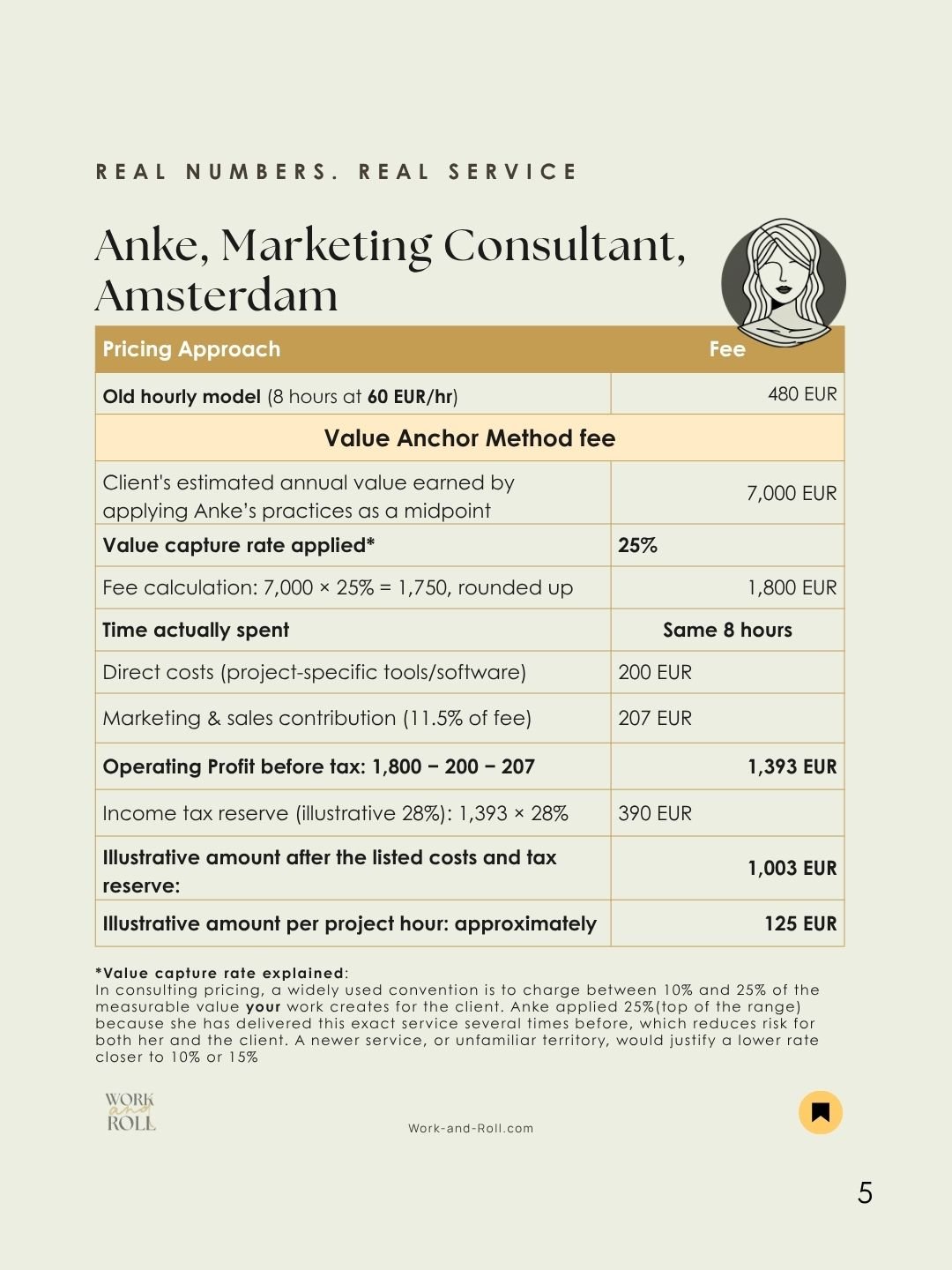
Charging on value with the full cost chain honest, she has 125 EUR per hour after tax. Not because the client paid more than the work was worth, but because the price finally reflected what the work delivered.
How Do You Set Your First Value-Based Price This Week?
Pick one service you currently sell by the hour, run it through all three steps of the Value Anchor Method with real numbers, and write down the new fee before you talk yourself out of it. This is, in practice, how to price services as a freelancer without capping your income to the hours in your day. You do not need to reprice your entire menu this week. You need one package and about thirty focused minutes.
How to Price Services as a Freelancer: The Short Version
- Start with the service that feels most underpriced right now, not the easiest one. Name the outcome the client walks away with. Estimate what that outcome is worth to her business, using the same 15-to-20-percent-of-margin logic Anke used, or whatever is honest for your work.
- Apply a value capture rate you can defend, 15 percent if the work is newer to you, 25 percent if you have done it many times.
- Then subtract every real cost: your direct expenses, your marketing and sales contribution, and your income tax reserve for the country you work in.
The gap between your old rate and the new one is not greed. It is the value you were already delivering, priced honestly for the first time. Every quarter you keep the old price is a quarter of that value walking out the door.
Your next steps: