
Something in your business feels off. You cannot quite name what. It might be money, it might be time, it might be a client who drains you more than she pays you, it might be all three at once. So you keep working, because stopping to look feels like it will cost you momentum you cannot spare.
You cannot fix what you cannot see. That is the whole problem with running everything yourself: there is no one else glancing at the dashboard, so nothing gets checked unless you check it.
This article gives you a business audit small business owner can actually finish, about two hours, not a multi-day consulting exercise. It is not a corporate tool borrowed and shrunk down. It is built for a woman running everything herself, and it does not require perfect data, only honest answers
Why Does “I'll Audit It Properly Someday” Never Actually Happen?
“I'll audit it properly someday” never actually happens because the word “audit” sounds like a week-long project with an accountant, so it gets postponed indefinitely, and the postponing is the real problem, not the business.
There is also a quieter reason it keeps getting pushed back. If everything already feels like it might be broken, actually looking feels like it will confirm the fear, and confirming it feels worse than not knowing.
So the safer-feeling choice is to keep moving, keep responding to whatever is loudest today, and never sit down with the whole picture at once. Being busy starts to feel like proof that things are fine, because a calendar full of calls and deadlines does not leave room to notice that half of them are not actually moving the business forward.
This confusion between busy and productive is worth naming directly, because it is doing more damage than the fear of finding a problem. A full week can be entirely reactive, client emergencies, admin catching up on itself, small fires that feel urgent in the moment, and still leave you no closer to your own goals at the end of it.
Busy tells you the day was full. It does not tell you whether the fullness was worth anything.
Here is the reframe that makes this manageable. This is not a formal audit in the corporate sense. It is a fast diagnostic, four areas, a page, about two hours on a weekend.
You are not producing a report for anyone else. You are answering ten honest questions for yourself, and the goal is clarity, not a perfect score. Nothing here requires flawless bookkeeping or a complete client history. An honest estimate, written down and looked at squarely, beats a perfect number you never calculate at all.
The Four Areas Where a Solo Business Actually Breaks
A solo business tends to break down in the same four places, regardless of what she sells: money, time, clients, and systems.
Revenue Clarity:
not whether money is coming in, but whether she actually knows if the business is profitable once every real cost is counted.
Time Allocation:
where her hours actually go, income-generating work versus admin, reactive firefighting, and everything in between.
Client/Product Health:
which relationships or offers are worth the energy they take, and which are quietly costing more than they return.
Systems and Tools:
what would break, or who would be stuck, if she were unavailable for a week.
Most audit templates are written for a business with a team and an accountant already checking most of this. When you run everything yourself, these four areas do not check themselves.
Small problems in each one compound quietly until a slow month or a difficult client forces the question you have been avoiding. None of the four areas is more important in principle than the others, but they are rarely equally urgent for any one business at any one time, which is exactly what this audit is designed to reveal.
Two European-specific checkpoints belong inside these four areas, not as a separate fifth worry, but folded into what you are already reviewing.
Under Systems and Tools, a fast compliance check costs nothing and catches a real risk early: GDPR is enforced with fines that can reach 20 million euros or 4 percent of global annual turnover for the most serious infringements, whichever is higher, and enforcement has reached small operators, not only large corporations. A two-minute check (“do I actually know what data I collect and where it is stored?”) is enough for this audit, a fuller review is a separate task.
Under Client/Product Health, if family members are involved in the business, family-controlled firms employ more than 40 percent of the workforce across the EU, and the European Commission's own Family Business Expert Group has documented role and governance clarity as a recurring challenge specific to family firms. If that sounds familiar, it belongs in your audit too.
The Weekend Business Mirror: A 4-Area, 10-Question Audit
The Weekend Business Mirror gives you four areas, two or three honest questions each, and one page, so you see the whole business at once instead of one worry at a time.
When you do it: Quarterly as a habit, or any time that low-grade “something is off” feeling shows up and will not go away.

Total Time Needed :
2
Hours
What will you need:
– A quiet space to think calmly and honestly
The Four Areas:

Answer honestly: do you know your real profit number, not your revenue, for the last three months?
If you have already run the What “Profitable” Actually Means for a Solo Business in Europe, European Profit Reality Check, use that number here. If not, estimate: revenue minus VAT minus real costs, including social security and tax
Ask yourself: “Am I actually profitable, or just busy?“

Look at last week, honestly, not the week you wish you had. What share of your hours went to work that generates income, versus admin and reactive firefighting?
Ask yourself: “Where did my time actually go, and did I choose that, or did it just happen to me?“

Name one client or product that takes the most energy for the least return. Then name the one that gives the best return for the least effort.
Ask yourself: “If I could only keep half of what I currently offer, what would stay?“

Name the one task that would cause the most damage if you were unavailable for a week, because no one else knows how to do it, including any compliance basics (GDPR, VAT filing dates) that only live in your head.
Ask yourself: “What breaks if I disappear for seven days?“
Business Audit Small Business Owner Checklist: The Short Version
If you only take one thing from this method: name your real profit, name where your time actually goes, name your best and worst client, and name what breaks without you. That is a business audit small business owner can finish alone, in one afternoon.
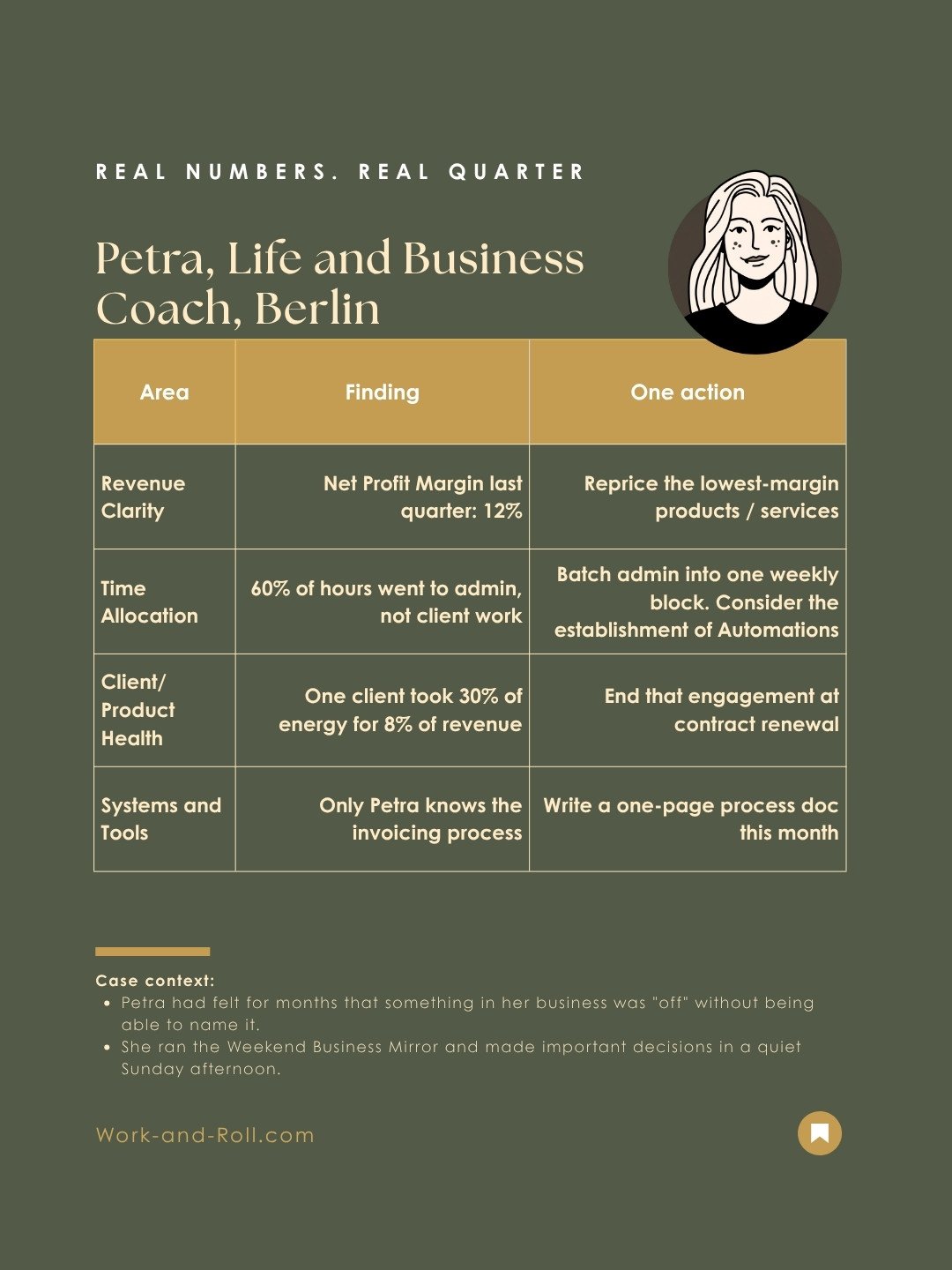
What Is Your Completed Mirror Telling You?
Your completed mirror is telling you which one area, if improved, would relieve the most pressure everywhere else, not that you must fix all four at once.
For some businesses that is Revenue Clarity, because once the real number is known, decisions about time and clients get easier. For others it is Client/Product Health, because one draining relationship is quietly poisoning the time and energy available for everything else.
There is no universally correct starting point, only the one your own page is pointing to.
Resist the urge to act on all four findings at once. That instinct is understandable, once you can finally see everything clearly, fixing everything immediately feels like the responsible move.
In practice it usually means starting five changes and finishing none of them, which leaves you more depleted than before you looked. Pick one area. Give it the next few weeks. Let the other three sit, written down and visible, but not yet in motion.
The 90-Day Plan for a Team of One article and its Solo Sprint Framework pair naturally with this step: once you know your one starting area, that becomes your next quarter's one focus, not a scattered list of everything you noticed.
If you complete the audit and know exactly what to do next, do it. If you complete it and feel stuck, staring at four honest findings with no clear next step, that is precisely the moment a Focused Business Strategy Session earns its place:
ninety to one hundred twenty minutes to turn what you found into a concrete plan, with someone else in the room who is not also the person who has to fix it.
Your next steps: