Sunday evening. You are not working, but part of your brain is still doing math it never finishes. Did that client pay? Is there enough for the software renewal on Tuesday? You do not check, because checking feels like it might confirm something bad, so the dread just sits there instead, unresolved, until next Sunday.
That feeling is not a sign you are bad with money. Real, well-documented research on small business owners backs this up: it is one of the most common experiences in running a business alone.
The instinct to avoid looking makes sense. When you run everything yourself, there is no colleague quietly keeping an eye on the numbers in the background. Every financial fact you don't know is a fact nobody knows, which makes not-knowing feel almost like a form of safety, even though it is the opposite.
This article gives you cash flow management for solopreneurs that takes about fifteen minutes a week, no accounting software, no spreadsheet expertise, just one short routine that turns a vague dread into one clear decision.
Why Does Cash Flow Feel Scarier Than It Should?
Cash flow feels scarier than it should because the fear is about timing, not profitability, and timing problems are much easier to fix than most people realize.
A Bluevine-commissioned study conducted by Centiment, surveying 781 small business owners in February and March 2026, found that 41 percent cite the gap between money coming in and bills coming due as their single biggest source of financial anxiety.
That ranks above both payroll (20 percent) and taxes (25 percent), which is worth sitting with for a moment. Most advice about business finances focuses on profitability and tax planning, but for four in ten owners, the thing actually keeping them up at night is neither of those. It's timing. This is US-based data, not European-specific, but the underlying pattern, that timing anxiety outranks profitability anxiety, shows up constantly in European solo business conversations too.
The same study found that 62 percent of owners have reduced or skipped their own pay at least once in the past year to cover business costs, and 68 percent lose at least one full night of sleep a month over cash-flow worry.
Here is the distinction worth holding onto: this is not the same problem as the one covered in Revenue Isn't Profit. That article is about whether your business is profitable at all. This one is about whether the money that is genuinely yours has actually arrived yet. You can be fully profitable on paper and still feel a constant squeeze, simply because of when money moves.
The Real Cost of Never Checking
The real cost of never checking your cash flow is not the occasional bad week, it is the compounding pattern of reactive, fear-driven decisions that a five-minute look would have prevented.
When you never sit down with the real numbers, every financial decision gets made under pressure: a purchase delayed too long, a client chased too late, a tax reserve that was never set aside because nothing ever prompted you to set it aside. Each of these, on its own, feels small. Stacked across a year, they are the difference between a business that has breathing room and one that always feels one bad month away from a crisis, even when the underlying numbers are actually fine.
European payment terms make this worse if you don't know the rhythm to expect. Under the EU Late Payment Directive, already covered in detail in [INTERNAL LINK: Revenue Isn't Profit], the default B2B payment term is 30 days, extendable to 60 if both parties agree.
If you don't track which of your outstanding invoices fall under extended terms, a payment that is actually on schedule can feel like a crisis, and a payment that is genuinely late can go unnoticed for weeks. Both situations cost you the same thing: the ability to tell the difference between normal and actually urgent.
Avoiding the check does not make the underlying numbers less true. It just means you find out about problems at the worst possible moment, instead of the earliest one.
The Weekly Money Date: A 3-Step Cash-Flow Routine
The Weekly Money Date is a three-step routine, designed to take under 15 minutes, that replaces vague financial dread with one clear decision each week.
When you do it: The same time every week, ideally paired with an existing habit (Sunday evening, Monday morning coffee) so it doesn't need willpower to remember

Total Time Needed :
30
Minutes
Required Tools:
– Your VAT rate
Follow the three simple steps:

Look at your real bank balance, then subtract any VAT sitting in that balance that isn't actually yours. This takes the balance from “what it looks like” to “what it actually is.”
Ask yourself: “Of what's in this account right now, how much is genuinely mine after VAT?“
Example:
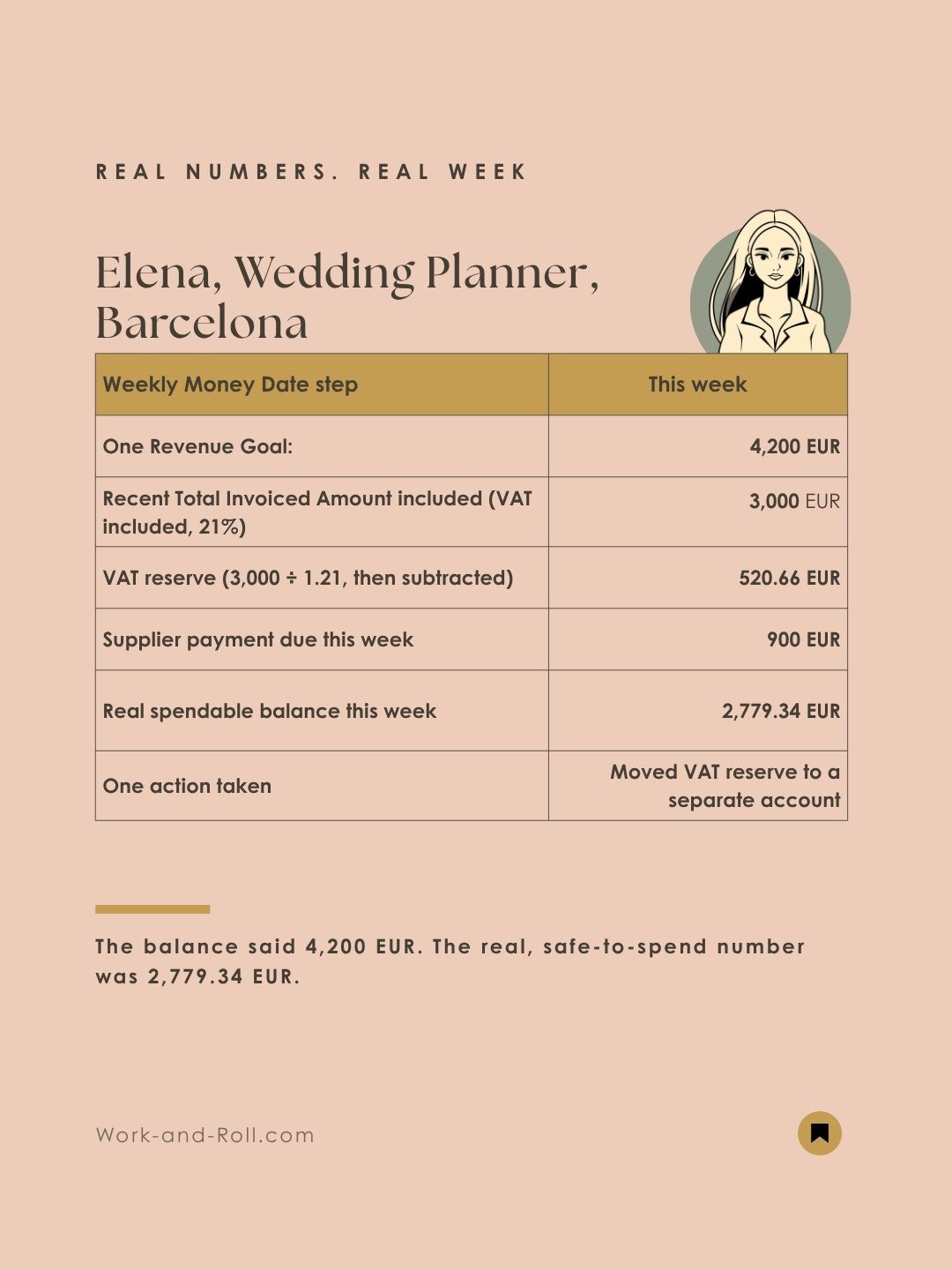
Bank balance shows 4,200 EUR. A recent Total Invoiced Amount of 3,000 EUR (VAT included, Spain's 21% rate) is part of that balance. Calculation: 3,000 ÷ 1.21 = 2,479.34 EUR net. VAT reserve needed: 3,000 − 2,479.34 = 520.66 EUR.

Note anything due to arrive or leave in the next 30 days: invoices you're expecting, bills you owe, and any tax or VAT filing deadline.
Ask yourself: “What is scheduled to move, in either direction, before my next Money Date?“
Example:
A supplier payment of 900 EUR is due this week. One outstanding client invoice is under agreed 60-day B2B terms and isn't due for another three weeks, so it is not yet a concern.

Pick exactly one thing to do this week because of what you just saw. Not a to-do list, one action.
Ask yourself: “Given everything above, what is the one thing that actually needs to happen this week?”
Example:
Transfer the 520.66 EUR VAT reserve to a separate account today, before it gets spent on something else.
Cash Flow Management for Solopreneurs: The Short Version
If you only take one thing from this routine: check the real number after VAT, flag what's coming in the next 30 days, and pick one action. That is cash flow management for solopreneurs distilled to fifteen minutes, no software required.
How Do You Make This Habit Actually Stick?
This habit sticks when it is anchored to something you already do every week and kept short enough that skipping it feels more annoying than doing it.
Pick a moment that already exists in your week: the coffee before you open your laptop, the ten minutes after Sunday dinner, whatever is already a fixed point. Attach the Money Date to that moment rather than trying to find new willpower for it. Habits that piggyback on something you already do survive far longer than habits that need their own dedicated motivation, especially in a week that gets busy.
Keep it to the three steps, on purpose. The temptation will be to turn it into a full financial review the first time something looks off. Resist that. A fifteen-minute weekly habit survives being small. A forty-five-minute one gets skipped the first busy week, and then the dread comes back.
If a week reveals something genuinely concerning, that is exactly what the routine is for, it caught it early instead of letting it surface in a month. Write down the one action, do it, and let the rest of the review end there. You can always add a deeper monthly check later, once the weekly habit is solid, but the fifteen-minute version has to work first.
Do it this week, even if last week was fine. The value of the Weekly Money Date isn't catching every problem, it's removing the Sunday-evening math your brain was already doing anyway, and replacing it with one honest look and one clear action.
Your next steps: